
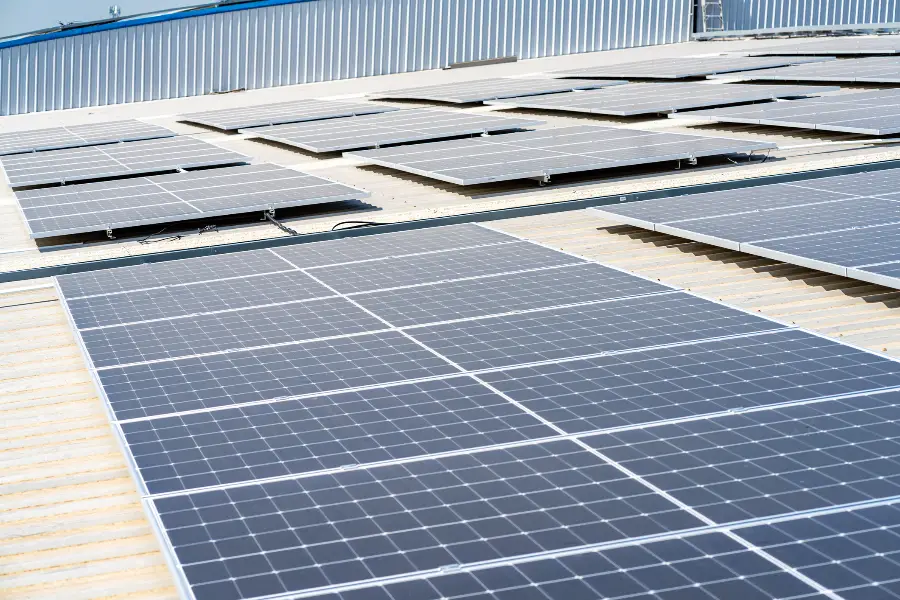
Commercial solar installations are productive assets. During periods of strong sunlight or reduced on-site demand, they often generate more electricity than a business can use, but that surplus does not have to go to waste. Through the Smart Export Guarantee, UK businesses can receive payment for the excess electricity their solar panels send back to the national grid, creating an additional revenue stream that contributes directly to overall solar energy ROI.
This guide explains how the scheme works, what businesses can expect to earn, and how export payments fit into the broader financial case for commercial solar.
The Smart Export Guarantee is a UK government initiative introduced in January 2020. It requires eligible electricity suppliers to offer payment to small-scale renewable energy generators for every unit of surplus electricity they export to the grid. Solar PV is one of the qualifying technologies, making the scheme directly relevant to businesses operating commercial solar systems.
Unlike its predecessor, the Feed-in Tariff, the SEG does not include a generation payment. It focuses solely on electricity that leaves the premises and enters the grid. Suppliers are free to set their own tariff rates, which means the payments available vary between providers. Exported electricity is measured through a smart meter, which must be in place before a business can register for the scheme.
Understanding the SEG is a useful starting point when assessing solar energy ROI, because export revenue represents a third income stream that many businesses overlook when they first consider installation.
The process follows a straightforward sequence. Solar panels on the business premises generate electricity throughout the day. During working hours, that electricity powers the building directly, offsetting the amount the business would otherwise draw from the grid. When generation exceeds demand, the surplus flows out through the meter and into the national grid. A smart meter records exactly how many units are exported. The business then receives payment from its energy supplier at the agreed SEG tariff rate, typically settled through a quarterly or annual payment.
For businesses weighing up ROI on solar panels, this flow matters because it means the installation is productive even when on-site demand is low. Weekends, bank holidays, and seasonal periods of reduced activity, which would otherwise leave generation going to waste, become opportunities to earn rather than simply idle. The financial benefit is modest compared to on-site consumption savings, but it is consistent and measurable. When calculating solar panel return on investment over a ten or fifteen-year period, export payments form a meaningful part of the cumulative return.
SEG tariff rates currently range from around 1p to over 15p per kWh, depending on the supplier and the specific tariff product. The variation is significant, and the rate a business secures will have a direct bearing on the value of its export revenue over the life of the installation.
The volume of electricity available to export depends on several factors: the size of the solar system, the amount of electricity the business consumes on-site during generation hours, local weather patterns, and how the system has been configured. A 50kWp rooftop installation on a warehouse that operates Monday to Friday will typically export a larger proportion of its output than a manufacturing facility running continuous shifts, simply because demand during weekends and overnight is lower.
For businesses modelling potential returns before committing to installation, a solar power ROI calculator can give a clearer picture of how system size, consumption profile, and tariff rate interact to affect total earnings. The point is not to overstate what export payments can deliver on their own, but to treat them as a legitimate and quantifiable element of the financial case. When viewed alongside reduced electricity bills, solar power return on investment across a typical commercial system becomes considerably more compelling than generation savings alone would suggest.
Commercial solar delivers financial value through three distinct channels. The first is the reduction in electricity drawn from the grid, which directly lowers bills at the prevailing unit rate. The second is access to government incentives and tax reliefs, including the current 0% VAT on commercial solar installations and capital allowances available under certain schemes. The third is export revenue through the Smart Export Guarantee.
Each of these contributes to solar energy ROI, but they work differently. Bill savings are immediate and continuous. Tax reliefs reduce the upfront cost of the investment. Export payments accumulate over time, growing in significance as tariff rates improve or as energy prices make the avoided cost of grid electricity higher. Together, they shorten the payback period and improve the long-term ROI on solar panels that a business can expect.
Using a solar power ROI calculator that incorporates all three income streams gives a more accurate projection than one focused solely on generation costs. Businesses that account for export revenue at the planning stage typically find that their projected payback period is shorter than initial estimates based on bill savings alone, and that solar panel return on investment over a fifteen-year system lifespan is more attractive than a conservative calculation might suggest.
Getting the most from the Smart Export Guarantee requires more than simply installing a solar system and registering for a tariff. Businesses that actively manage their generation and consumption tend to earn more from exports over time:
Here are tips for you to follow:
Several major UK energy suppliers currently offer Smart Export Guarantee tariffs to eligible commercial customers. These include Octopus Energy, EDF Energy, E.ON Next, and British Gas, though the tariff products, rates, and eligibility conditions differ between them.
Some suppliers offer fixed-rate SEG tariffs, which provide certainty about export earnings over a set period. Others offer variable or time-of-export rates, which can pay more during periods of high grid demand but require more active management.
Businesses should review the current rates available from each provider and assess them against their expected export profile before selecting a contract. Choosing the right tariff is a practical step towards improving solar power return on investment over the long term, and it is one that is often overlooked in the focus on installation and equipment costs.
Export payments are a genuine and reliable contributor to solar energy ROI, but they work best when understood in context. The greatest financial benefit from a commercial solar installation almost always comes from on-site consumption. When a business uses solar electricity directly, it avoids paying the full grid unit rate for that electricity, which is considerably higher than most SEG tariff rates. Maximising self-consumption should therefore remain the primary goal of any commercial solar strategy.
That said, surplus generation is inevitable in most commercial settings, and receiving payment for it through the Smart Export Guarantee is straightforwardly better than sending it to the grid for nothing. For businesses with lower weekday demand, weekend operations, or significant roof space relative to their consumption, export revenue can be a meaningful addition to overall solar panel return on investment. For high-consumption sites running continuous operations, the surplus available to export may be smaller, but it is still worth capturing.
Taken together, bill savings, tax relief, and export income make the solar power return on investment case for commercial solar installations more robust than many businesses initially expect. The SEG is not the primary driver of that return, but it is a consistent and measurable part of it.
Understanding how the Smart Export Guarantee works is one part of the picture. The other is knowing what a commercial solar installation would actually cost, generate, and return for your specific property and energy profile.
Go Solar Compare makes it straightforward to find out. Fill in the simple quote form and receive free, no-obligation quotes from MCS-accredited commercial solar installers in your area. All installers in the network are fully vetted and certified, so you can compare pricing and service options with confidence and choose the one that fits your business needs. There is no sales pressure and no obligation to proceed.


2026 © Go Solar Compare