
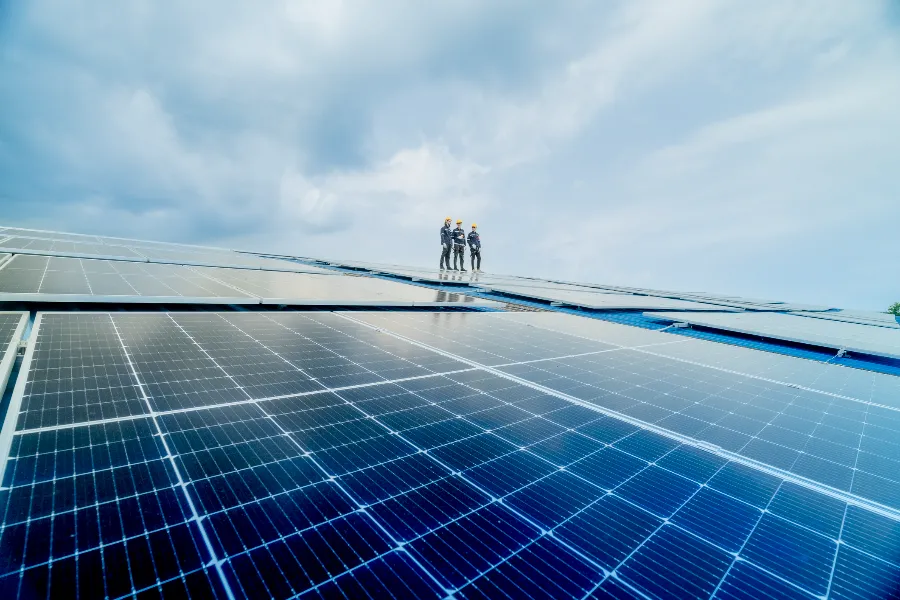
UK electricity prices have nearly doubled in recent years, and businesses are feeling it. Commercial solar panel costs are now a serious boardroom conversation, driven by rising energy bills, tightening sustainability targets, and a growing range of government incentives.
At Go Solar Compare, we’re here to help you cut through the confusion, giving you a clear, practical breakdown of what solar actually costs, what you can realistically save, and whether the return on investment makes sense for your business.
Understanding the solar panel cost for businesses starts with system size. As a general guide, here is a rough estimate of what you can expect to pay for a commercial solar installation in the UK:
For solar panels for commercial buildings, several variables influence the final price. Roof size and structural condition play a significant role, as do the efficiency rating of the panels specified and the complexity of the installation itself. Grid connection requirements, particularly for larger systems, can add to the overall budget, as can the inclusion of monitoring technology.
If you want a more precise figure, the commercial solar panel cost per square foot will vary depending on your roof layout, shading, and the system specification recommended for your premises.
One of the most compelling arguments for solar is what it actually costs to generate your own electricity. The commercial solar cost per kWh when generating onsite is typically around 4–5p, compared to the 20–25p per kWh most UK businesses currently pay to the grid. That difference is substantial, and it compounds over time.
Rather than purchasing electricity at a volatile market rate, you are producing it at a predictable, low fixed cost. As grid prices continue to rise, the value of every unit you generate increases accordingly. This is what makes solar a long-term financial asset rather than simply an environmental gesture. Commercial solar panel costs associated with installation are a one-time capital outlay; the electricity your system generates over the following decades comes at a fraction of what the grid would charge. For energy-intensive businesses, this shift in cost structure can be transformative.
The savings from solar panels for commercial buildings depend on system size, energy usage, and how much of the generated power you consume directly. A 25kW system, for example, may save a business around £4,000–7,000 per year, while larger installations can deliver savings of £15,000–25,000 or more annually.
Self-consumption is the key driver here: the more solar electricity you use directly rather than drawing from the grid, the greater your savings. Businesses that operate during daylight hours are particularly well placed to maximise this.
Beyond self-consumption, the Smart Export Guarantee (SEG) [1] allows businesses to earn revenue by exporting surplus electricity back to the grid, adding another income stream to the equation. There is also the matter of energy price inflation protection: once your system is installed, you are shielded from future grid price increases on the proportion of energy you generate yourself.
Commercial solar panel costs are a capital investment, and like any investment, the return matters. Typical ROI for commercial solar in the UK sits between 12% and 20% annually, with most businesses reaching payback within four to six years. Given that quality solar panels carry a lifespan of 25 years or more, the post-payback period represents a significant stretch of near-free electricity generation.
Once the system has paid for itself, your ongoing costs are minimal, consisting mainly of routine inspections and occasional cleaning. The electricity your panels produce beyond that point effectively costs you nothing. For businesses facing rising energy bills and pressure to demonstrate financial prudence, that kind of long-term cost certainty is difficult to ignore. Compare that return against other capital investments, and solar holds up well.
No two commercial solar installations are identical, which is why commercial solar installation cost estimates vary as widely as they do. The main variables to be aware of include:
Factoring in commercial solar panel maintenance from the outset is also sensible. Maintenance costs are generally low, but they should be included in any realistic financial projection.
The financial case for solar panels for commercial buildings is strengthened considerably by the support available to UK businesses. The Annual Investment Allowance (AIA) [2] allows companies to claim full tax relief on qualifying solar investments in the year of purchase, which can significantly reduce the effective commercial solar installation cost.
The Smart Export Guarantee (SEG) provides ongoing income by paying businesses for every unit of surplus electricity exported to the grid. On the subject of VAT on commercial solar PV installations, businesses registered for VAT can generally reclaim it on qualifying installations, which further improves the overall return.
Beyond direct financial incentives, there are strategic benefits too. Solar supports energy cost hedging by locking in lower generation costs regardless of future grid prices. For organisations with ESG commitments, investing in renewable energy also contributes to sustainability reporting and net-zero planning, which carries increasing weight with investors, clients, and regulators alike.
For the right business, the answer is straightforwardly yes. Commercial solar panel costs are offset by strong returns, predictable savings, and a growing range of financial incentives. Solar tends to deliver the greatest value for businesses that:
Beyond the financial case, solar also supports broader organisational goals. For businesses working towards net-zero targets, solar is one of the most practical and measurable steps available. It contributes directly to corporate sustainability reporting and demonstrates a tangible ESG commitment to stakeholders.
Ongoing commercial solar panel maintenance requirements are minimal, meaning that once installed, the system delivers returns with very little management overhead. For many UK businesses, the question is no longer whether solar is worth it; it is how soon they can get started.
Comparing commercial solar panel costs across multiple installers is the smartest way to ensure you are getting the right system at the right price. At Go Solar Compare, all installers in our network are fully accredited and vetted, so you can compare quotes with confidence. Fill in our simple contact form today and receive free, no-obligation quotes tailored to your premises and energy needs.
[1] Ofgem, “Smart Export Guarantee (SEG)”: https://www.ofgem.gov.uk/environmental-and-social-schemes/smart-export-guarantee-seg
[2] GOV.UK, “Annual Investment Allowance (AIA)”: https://www.gov.uk/capital-allowances/annual-investment-allowance


2026 © Go Solar Compare