
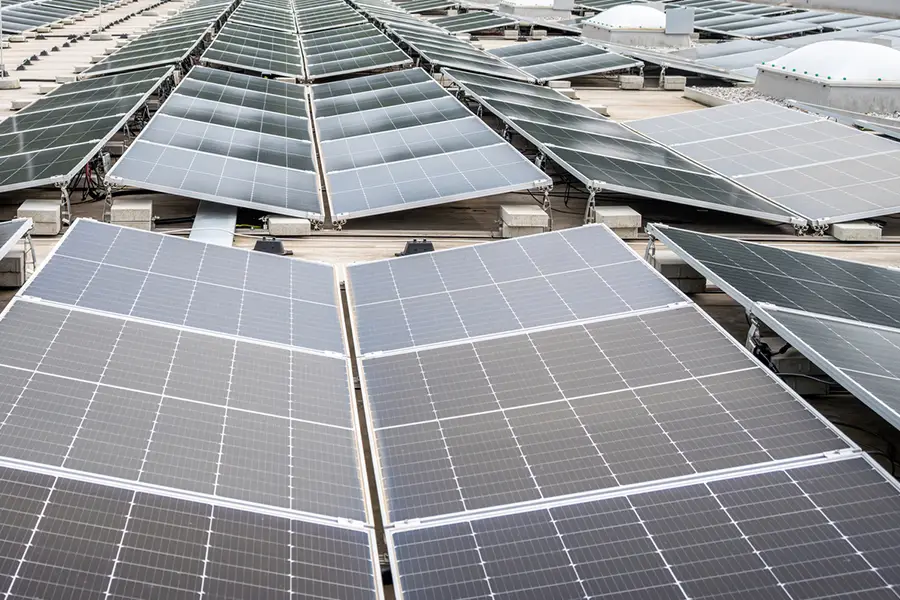
More UK businesses are turning to solar as a practical way to reduce energy costs and make better use of their buildings. For many commercial properties, the roof is the obvious starting point, and flat roofs in particular offer real advantages when it comes to installing flat roof solar panels.
Whether you own a warehouse, an industrial unit, or a retail premises, understanding how the process works is a useful first step before requesting quotes. And that’s what we intend to cover below, so you’ll have a far better understanding.
Commercial flat roofs tend to offer exactly what a solar installer needs, and that’s space. Unlike pitched roofs, which constrain panel layout and orientation, flat roofs give installers far more flexibility. Arrays can be positioned to face the optimal direction and set at the most productive angle, rather than being limited by the slope of the building itself.
It is worth noting that flat roof solar panels are not laid completely flat. PV panels on flat roofs are typically mounted on angled frames, tilted to improve sun capture, reduce dirt build-up, and make maintenance more straightforward.
For larger commercial buildings, this approach means a flat roof with solar panels can deliver strong generation potential, often with fewer obstructions than you would encounter on a pitched roof.
Choosing the right mounting system is one of the most important decisions in any flat roof solar installation, and there are three main options for flat roof PV panels to consider:
Before any flat roof solar panels are fitted, a thorough structural assessment is essential. This is not a formality. Ballast can add considerable weight to a roof, and installers need to confirm that the building’s structure can support it safely.
Key factors reviewed during this stage include roof load capacity, deck and substructure strength, wind uplift risk, and the total ballast weight the system would require. PV panels on flat roofs also introduce long-term loading considerations, so the condition of the roof matters as much as its current strength.
If a roof is approaching the end of its service life, it is generally advisable to address any repairs or refurbishment before installation begins. Dismantling a solar array to carry out roof work later is both costly and disruptive, and a competent installer will flag this risk early.
Concerns about roof leaks are common among commercial property owners considering solar, and they are worth taking seriously. The good news is that modern mounting systems, particularly ballasted ones, are specifically designed to protect the waterproof membrane rather than compromise it.
Because ballasted flat roof PV panels sit on frames rather than being fixed through the roof surface, they can avoid penetrating the waterproofing layer entirely. That said, even a well-chosen system needs careful installation. Drainage routes must remain clear, weight must be distributed evenly, and access for future maintenance needs to be planned from the outset.
A flat roof with solar panels can also raise questions around roof warranties. Reputable installers will typically coordinate with the roof manufacturer or conduct a post-installation inspection to confirm that the warranty remains valid. It is a detail worth raising when you compare quotes.
So, what happens when a solar system is fitted to a flat roof? The process for a commercial flat roof solar installation generally follows these stages:
For most commercial installations, the process takes several days to a few weeks. Larger arrays, complex roof structures, or sites requiring planning approvals may take longer. It is worth noting that the process for solar panels on flat garage roofs follows the same general principles, though the scale and engineering requirements are typically simpler.
There is no single answer to this, because output depends on several variables: system size, the roof space available, panel efficiency, shading, and the building’s location across the UK. What can be said with confidence is that large commercial roofs have the potential to support substantial arrays, sometimes numbering in the hundreds of panels.
To put that in practical terms, a warehouse with a large, lightly shaded roof could generate enough electricity to cover a significant proportion of its daytime energy use, reducing the amount it draws from the grid during working hours. For businesses with high daytime consumption, that is a meaningful saving.
Flat roof PV panels are often presented as both a cost-control measure and a way to reduce the building’s carbon footprint, and in the right circumstances, they deliver on both.
Not every flat roof is automatically a good candidate for commercial solar installation, and it is worth understanding what installers look for before assuming your building qualifies. The factors that tend to matter most are roof size and usable layout, the degree of shading from nearby structures or rooftop plant, the age and condition of the roof surface, and the structural capacity to carry the system.
For UK commercial properties, planning rules are also a consideration. Permitted development rights for PV panels on flat roofs vary depending on building type, and office buildings in particular often require planning permission. Industrial premises, schools, and logistics facilities tend to face fewer restrictions, but the rules differ by location and designation, so it is worth checking before you proceed.
If you are comparing a flat roof solar installation against other options, such as other roof types, a professional survey will give you a much clearer picture of what is feasible and what a realistic system might cost.
If your building has a flat roof with solar panels as a possibility, the next step is to get a clear picture of what is available in your area. Go Solar Compare connects you with fully accredited, MCS-certified installers who can assess your roof and provide competitive quotes.
Fill in the simple form, compare your options, and choose the one that fits your building and your budget. It’s really that easy!


2026 © Go Solar Compare