
The scenario: your energy bill arrives and you wince. If this sounds familiar, then you’re just one out of millions of UK households asking the same question: is there a better way? With the government’s solar expansion initiative gaining real momentum in 2026, the answer is closer than many people realise [1].
Renewable energy in the UK is no longer a niche ambition; it’s becoming mainstream policy. Yet for most homeowners, the challenge isn’t awareness. It’s knowing where to start, what support is available, and whether it’s genuinely worth the investment. This guide cuts through the noise, so you can make an informed decision about how solar could help you reduce energy bills.
The UK government has made its position clear: solar power is central to the country’s long-term energy strategy [2]. Backed by legally binding net zero targets, policy direction in 2026 is firmly focused on scaling up domestic generation capacity, reducing dependence on imported fossil fuels, and accelerating the transition to clean power.
When it comes to solar panels, government support has taken several forms in recent years, from planning reforms that make installation simpler to funding streams aimed at widening access. The government’s commitment to renewable energy in the UK is reflected in its targets for solar capacity, with rooftop installations seen as one of the most efficient and scalable routes to achieving them.
This solar expansion isn’t happening in isolation either. It connects directly to the broader national grid strategy, with local generation increasingly valued as a way to stabilise supply and reduce pressure on ageing infrastructure. As far as this concerns solar panels, government support continues to evolve, with new-build regulations and retrofit incentives both forming part of the picture.
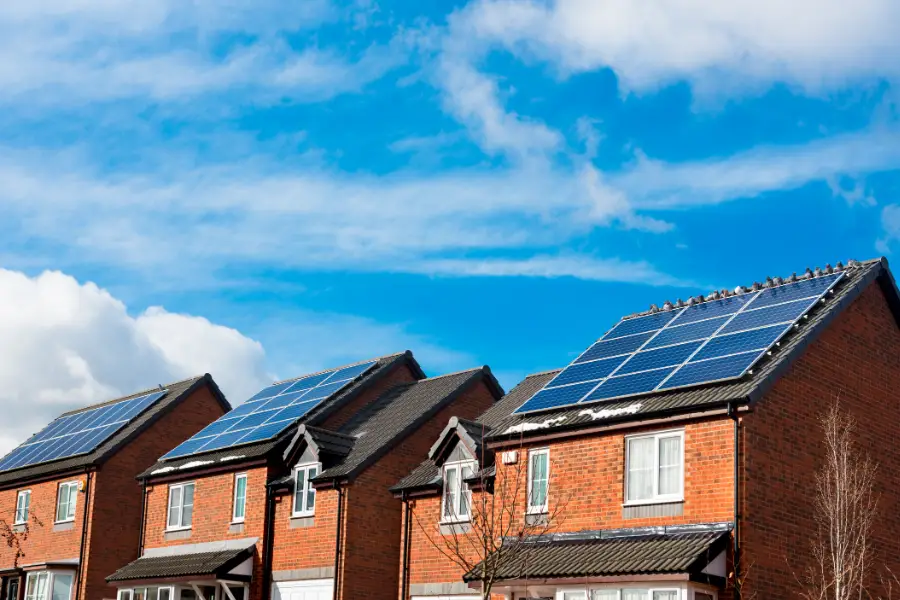
Here’s a shift worth understanding. Rather than relying solely on remote solar farms to power the grid, government strategy increasingly treats rooftops as a national energy asset. Millions of suitable residential and commercial roofs across the UK represent enormous, untapped generation potential, and policy is beginning to reflect that.
New-build homes are under growing pressure to incorporate rooftop solar as standard [3], while commercial properties and warehouses are being encouraged to make use of their considerable roof space. This decentralised approach to solar expansion means that electricity can be generated right where it’s used, reducing transmission losses and improving resilience.
For homeowners, this shift is significant. Solar is no longer seen as a premium upgrade; it’s fast becoming an expected feature of a modern, energy-efficient home. With home solar installation more accessible than ever, the conversation has moved from “should I consider it?” to “how do I get started?”
Understanding the practical and financial case for solar for homeowners in the UK is essential before making any decisions. The benefits are real, though they vary depending on your system size, energy usage, and location.
Here’s what a well-sized home solar installation could mean for you:
The ability to earn from surplus generation, in particular, represents a genuine income stream rather than just a feel-good addition.
One of the most common misconceptions about solar is that meaningful support no longer exists. In reality, solar incentives in 2026 are broader than many people realise, and the ongoing solar expansion has prompted both government and local authorities to maintain and develop accessible support routes.
Current and recent support mechanisms include:
Eligibility varies, so it’s always worth checking current schemes in your region before committing.
The trajectory for renewable energy in the UK is clear, and the next few years are likely to bring changes that make rooftop solar even more compelling for homeowners. Technology costs continue to fall, installer competition is increasing, and the market is maturing in ways that benefit consumers.
Battery storage is becoming a more common addition to home solar installation, allowing households to store daytime generation for use in the evening rather than exporting it. This improves self-consumption and reduces grid reliance further. The Smart Export Guarantee will likely evolve too, with rates and eligibility continuing to be shaped by market conditions and policy priorities.
Perhaps most significantly, solar panels look set to become standard on new homes within the coming planning cycles. For existing homeowners, that shift underscores the direction of travel. Acting sooner rather than later means more years of savings, more protection against bill increases, and more time to benefit from the changing energy landscape.
The UK’s solar expansion is creating real opportunities for homeowners, but navigating the options alone can be daunting. At Go Solar Compare, we make the process straightforward. Simply fill out our quick contact form, and we’ll match you with fully accredited MCS-certified installers who are ready to provide competitive home solar installation quotes, tailored to your property and needs.
There’s no obligation and no sales pressure, just clear, comparable quotes from trusted professionals so you can make a confident decision. Our service is completely free to use, with the best deals updated daily. Start comparing today and see what solar could mean for your home.
[1] GOV.UK, “With the government’s solar expansion initiative gaining real momentum in 2026, the answer is closer than many people realise”: https://www.gov.uk/government/publications/solar-roadmap/solar-roadmap-united-kingdom-powered-by-solar-accessible-webpage#part-2-actions-to-address-key-challenges
[2] GOV.UK, “The UK government has made its position clear: solar power is central to the country’s long-term energy strategy”: https://assets.publishing.service.gov.uk/media/6194dfa4d3bf7f0555071b1b/net-zero-strategy-beis.pdf
[3] GOV.UK, “New-build homes are under growing pressure to incorporate rooftop solar as standard”: https://www.gov.uk/government/news/rooftop-solar-for-new-builds-to-save-people-money
[4] Ofgem, “Through the Smart Export Guarantee, you can sell surplus electricity back to the grid and receive payments from your energy supplier”: https://www.ofgem.gov.uk/environmental-and-social-schemes/smart-export-guarantee-seg
[5] GOV.UK, “The removal of VAT on energy-saving materials, including solar panels, remains in place and represents a meaningful cost reduction”: https://www.gov.uk/tax-on-shopping/energy-saving-products


2026 © Go Solar Compare