
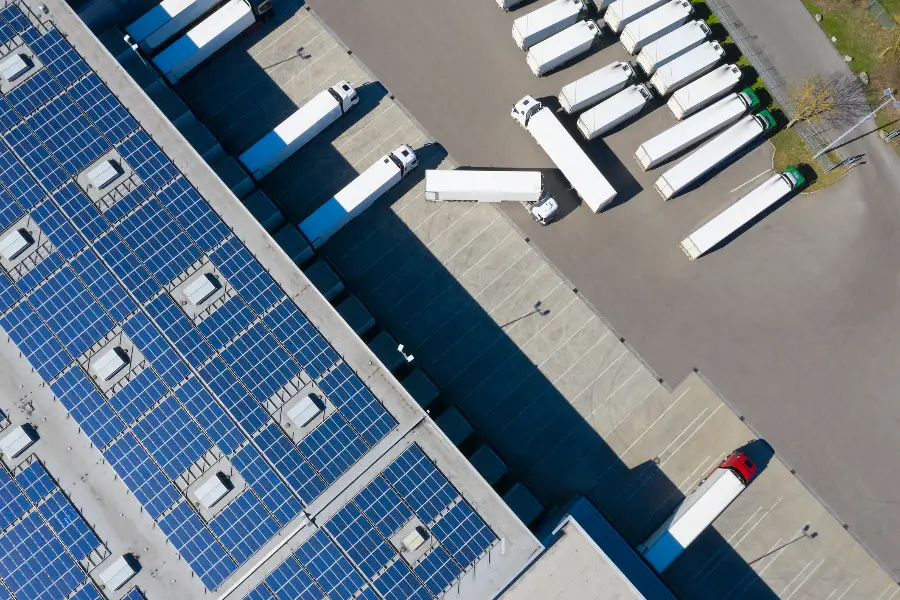
Energy costs are one of the most significant overheads for any industrial operation, and that pressure has pushed more warehouse owners and facilities managers to look seriously at on-site generation. Solar panels for industrial buildings offer something that the grid cannot: a fixed, predictable source of electricity produced directly from the roof above your head.
With large surface areas sitting unused and daytime energy demand running consistently through operational hours, solar panels for warehouses are a practical fit rather than an aspirational one. This guide covers how solar works at an industrial scale, what it costs, and what kind of returns businesses are actually seeing.
The structural case for solar in an industrial setting is straightforward. Warehouses offer roof areas that dwarf what is available on any residential property, and that scale translates directly into generation capacity. More usable roof space means more panels, more output, and a greater share of your electricity needs met from your own system.
Flat roofs, which are standard across much of the UK warehouse stock, add a further advantage. Unlike pitched residential roofs, where orientation is fixed, flat roof installations allow panels to be angled for optimal solar output regardless of which direction the building faces. Shading is also less of an issue on open industrial estates.
There is a strong operational logic to solar panels for industrial buildings, too. Warehouses and distribution centres consume the most energy during daylight hours, precisely when a solar system generates at its peak. That alignment between supply and demand is one of the core reasons industrial solar energy delivers such a clear financial case.
System size is determined by available roof space and energy consumption, both of which are considerably larger in an industrial context than in a residential one. Solar panels for industrial buildings are sized in kilowatts, and the range varies significantly depending on the type of facility.
Typical system sizes by building type:
At the upper end of this range, a single rooftop can support hundreds or even thousands of panels. Solar panels for warehouses at this scale can meet a substantial share of a facility’s electricity demand, with surplus generation exported to the grid. Plus, solar panels for industrial units of all sizes follow the same core installation process, scaled to suit the building.
Business solar panel installation at an industrial scale is a significant capital investment, but one that typically delivers clear returns over its lifetime. Industrial solar panel costs vary depending on system size, roof structure, grid connection requirements, and mounting systems.
As a working guide for UK commercial projects, a 50 kW system costs roughly £45,000 to £60,000; a 100 kW system sits at £80,000 to £110,000; installations of 500 kW and above generally start at £350,000. These are broad ranges, and quotes from accredited installers are the only reliable way to confirm costs for a specific site.
Payback periods for business solar panels typically fall between four and seven years. Solar panels last 25 years or more, so the period of reduced-cost generation substantially outweighs the upfront spend. For solar energy for businesses at this scale, the long-term savings on electricity are considerable.
Most UK warehouses are built with flat or low-pitch roofing, and business solar panel installation on these structures follows a well-established approach. Rather than fixing panels directly to the roof membrane, installers typically use one of two methods.
Ballasted mounting systems use weighted frames to hold the panel array in position without penetrating the roof surface, preserving weatherproofing and often reducing installation time. Tilt frames raise panels to a fixed angle, usually between 10 and 15 degrees, to optimise output across different seasons.
Industrial solar energy installations at this scale also require careful load distribution assessment. A large array adds meaningful weight to a roof, and professional installers will always conduct a structural survey before work begins. Business solar panel installation carried out without this step creates unnecessary risk, which is why accredited installers are essential.
The financial logic of industrial solar energy is clearest when you look at electricity costs rather than system costs. Grid prices have risen significantly in recent years, and the long-term trend remains upward. A solar system generates electricity at a cost typically far lower than current grid rates once the installation is spread across its lifespan.
For warehouse and logistics operations with consistent daytime energy use, the savings compound quickly. Industrial solar panel costs are front-loaded: you pay upfront, then benefit from reduced bills for the next 25 years or more. Payback periods of four to seven years are common, and solar panels for industrial buildings often perform towards the shorter end of that range.
Larger systems also tend to deliver stronger proportional returns, as cost per kilowatt falls as system size increases.
Beyond the direct savings on electricity bills, solar energy for businesses in the UK benefits from several schemes that can improve the financial case further. Understanding these incentives is worth doing before committing to a system, as they can make a meaningful difference to the net cost and payback period.
Capital allowances allow businesses to deduct the cost of qualifying plant and machinery, including solar installations, from their taxable profits. The Annual Investment Allowance (AIA) extends this further, offering full upfront deduction of eligible capital expenditure up to a set threshold in the year of purchase, which can bring the effective net cost of a system down considerably depending on a business’s tax position.
Business solar panels that generate more electricity than the site consumes can also benefit from the Smart Export Guarantee (SEG). Under this scheme, energy suppliers are required to offer a tariff for surplus electricity exported back to the grid, turning excess generation into a revenue stream rather than wasted output. Taken together, these incentives mean that the true cost of a commercial solar installation is lower than the headline figure, and the return timeline shorter than it might first appear.
When it comes to solar panels for warehouses, not every building is an equally strong candidate, and there are several factors that a qualified installer will assess before recommending a system. Understanding these in advance helps set realistic expectations and ensures the process moves efficiently once you begin requesting quotes.
The key assessment areas are:
Solar panels for industrial units that have roofs which are approaching the end of their serviceable life may require roofing work before installation, which will affect both cost and timeline. Grid connection capacity is also worth understanding early. Larger systems sometimes require upgrades to the connection infrastructure, and these are costs that need to be factored into the project budget.
Business solar panels deliver their best returns when the site is assessed properly from the outset, which is why comparing quotes from multiple accredited installers, rather than proceeding on a single recommendation, is always the more prudent approach.
Warehouses and industrial buildings are among the strongest candidates for solar panels for industrial buildings in the UK, combining the roof space, the energy demand, and the financial scale to make a compelling case. If you are exploring solar energy for businesses and want to understand what a system could deliver for your site, Go Solar Compare connects you with fully accredited commercial installers who can assess your building and provide competitive quotes.
Fill in the simple form, compare your options, and choose the installer that fits your needs. There’s no obligation to commit, and you don’t have to worry about pressure sales.


2026 © Go Solar Compare